


Cracks in the System -- What Winter Storm Fern Revealed about Infrastructure Preparedness
A Dose of Reality
The January 2026 winter storm was a brutal reminder that weather doesn't just impact travel—it tests the physical limits of our infrastructure. As of February 2, 2026, the Tennessee Department of Health has confirmed 25 fatalities. Governor Lee announced a request for an Expedited Major Disaster Declaration for 23 counties.
With the addition of over 300,000 power outages across the state and Shelby County facing $5 million in the cost of damages, Tennessee saw the roughest outcomes from Winter Storm Fern.

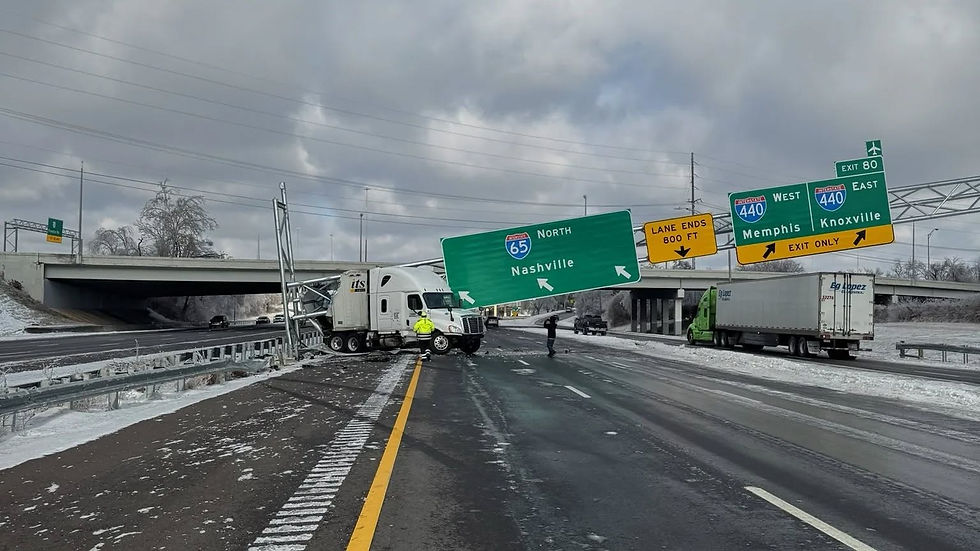
For those of us in manufacturing and the sign-making industry, the accident in Nashville also caught our eye. On I-65, a semi slipped on the icy road conditions and crashed into a support pole. The impact caused the sign and the rest of the overhead structure to collapse, closing I-65 at the I-440 split for hours on January 26, when storm conditions alone were causing traffic and dangerous road conditions.
Our focus on winter preparedness and the need for early action is precisely because of accidents like these: now there is the added cost of structural damage along with damage to the road. This increased traffic on two busy interstates during one of the worst storms Tennessee has ever seen, increasing the likelihood of more accidents and creating more obstacles for emergency response vehicles.
Signs of the Storm: Impact & Integrity
When we discuss the interstate sign collapse, we have to look at the big picture. The failure wasn't caused by the weight of the ice; it was a chain reaction. A semi-truck lost control on black ice and struck the vertical support of a massive overhead sign. In winter conditions, sign supports aren't just holding up metal; they are part of a roadside safety system.
This incident highlights technical needs for 2027:
Impact-Resilient Engineering: We must prioritize high-strength supports and reinforced footings that can withstand lateral vehicle strikes during "low-friction" weather events.
Pretreatment and Treatment of High-Traffic Roads: Interstates and roads need to be treated prior to freezing. If a storm has continued for several days and the roads have accumulated more ice, then the roads need to be treated again, or traffic has to be limited on those roadways.
Proactive Plans for Road Safety: If roads cannot be treated a second time, or if they haven't been treated at all, then a plan needs to be in place. Traffic cannot be allowed to travel as though normal when conditions are far from normal. These plans need to be set in advance, with proper and visible signage that has clear messaging.
Extruded Aluminum Advantage: Large-scale signs should utilize Extruded Aluminum Panels. Unlike flat sheets, the internal ribbing of an extruded panel acts as a structural spine, helping the sign maintain its shape even during the intense physical forces of a support failure.
When the support structure fell, it is thanks to engineering and maybe a little bit of luck that the sign stayed in place. Emergency response was able to focus on just the damage from the support structure, versus additional damage of a massive fallen sign.
The storm had started on Friday, January 24. The crash occurred on the following Sunday, meaning there were two days where the storm was active, and yet the interstate still had enough ice to throw a semi-truck out of control.
According to the Tennessee Emergency Management Agency, 1.8 million gallons of brine and 101,000 tons of salt were utilized by the Tennessee Department of Transportation. This report was published on February 2, and the wording is as follows: "These figures help illustrate the scale of the effort." It is unclear when action was taken and if these actions were proactive or reactive.
Messaging Problems: The Communication Gap
Engineering is only half the battle; the other half is communication. According to TEMA Flash Report #11, there were nearly 3,000 motorist assists during the storm. Many of these occurred because of a "Messaging Gap." State warnings were delayed, and when the signs finally flickered on, they often displayed generic "Caution" alerts.
In 2026, generic isn't enough. Driver uncertainty leads to "panic braking" and higher traffic volumes during the most dangerous hours of a freeze. The Signways Standard calls for Actionable Wayfinding—specific data like "Exit 42 Closed" or "Warming Station 2 Miles" to give drivers the clarity needed to get off the road before an accident happens.
Learning from the Past
Tennessee experienced a similar crisis during the 1994 Ice Storm yet handled 2026 as though starting from scratch. The controversy surrounding the timeline for calling in Mutual Aid utility crews and clearing teams suggests that their response remains reactive rather than proactive.
Strengthening infrastructure before the storm hits, by installing better supports and higher-grade sheeting, reduces the need for frantic emergency repair during a crisis. Planning for road closures and detours with optimized signage decreases traffic on dangerous roadways, cutting down on the number of accidents. When our signs stay standing and our messages are clear, emergency crews can focus on restoring power and saving lives rather than clearing debris from the interstate and directing traffic.
A Winter Storm Roadmap for 2027
To ensure 2027 is different, we propose four immediate strategies for state and local planners:
Corridor Care: Prioritize high-traffic roads with 48-hour pre-treatment and high-visibility signage for road closures, detours, and warming centers.
Planning Alternate Routes: Create a plan for safer, alternate routes travelers can take during a weather emergency. Account for how these routes will be indicated with clear, legible signage. This will divert traffic and decrease the amount of drivers on busier interstates and highways.
Proactive Structural Audits: Use the upcoming seasons to audit all overhead supports for hardware fatigue or corrosion that Storm Fern may have accelerated.
Advanced Warning Windows: Implement travel restrictions earlier via digital and static signage to keep lanes clear for salt crews and emergency vehicles.
Takeaway
Safety shouldn't be a reaction to a crisis; it's a standard we build into the systems that protect our homes.
Interstate Signways is always looking at how we can do better, whether it's via our delivery system, using the newest tech, or featuring the highest quality sheeting available. We do this because it keeps people safe while on the road.
With so many lives lost last week, let's do better to prepare for extreme weather in the future.


Posso confermare che la scrittura mantiene un tono neutro e obiettivo. Un'attenzione proporzionale agli indicatori verificabili è mantenuta. Il sito web documenta il panorama più ampio che circonda questo argomento. I flussi di coinvolgimento degli utenti sono contestualizzati dai servizi multimediali interattivi.
Reading from Pitney Bowes reviews I had the pleasure of using and I couldn't be happier with the experience! The platform is incredibly user-friendly, making it a breeze to manage my shipping needs. I was impressed by the speed and efficiency of their services; my packages arrived on time and in perfect condition. The customer support team was also fantastic, always ready to assist with any questions I had. Overall, I found the entire process to be seamless and enjoyable. I highly recommend Pitney Bowes for anyone looking to simplify their logistics!
Reading this really hit home, Winter Storm Fern exposed just how vulnerable our infrastructure can be when extreme weather strikes. It’s not just one system failing; it’s power outages, road closures, and service disruptions all piling up at once. Makes you realize that “preparedness” can’t just mean fixing things after the fact, it has to be about smarter planning and stronger systems now, so the next storm doesn’t throw everything into chaos.