


2,000 Miles of Damage - Winter Storm Fern's Devastating Wrath
This past weekend, another massive winter storm hit the nation, keeping us in our homes for up to five days. Winter Storm Fern stretched over 2,000 miles, affecting 230 million people from New Mexico to New England. This weekend, over 1 million people lost power, primarily in Tennessee, Mississippi, Louisiana, and Texas. Originally called a "major system," the storm transformed into a catastrophic ice and snow event for over half the nation.
Since we're still in our month of winter weather preparedness, let's take a closer look at the storm, how states prepared, and the effects unfolding in real time.

Taking Charge — Winter Weather Preparedness
Over thirty states were under a National Weather Service Watch on Saturday morning, with over twenty declaring states of emergency before the onset of weather.
(For general measures to take prior to a winter storm, see our previous post or below, for additional resources.)
For Winter Storm Fern, some states implemented extra safety measures to prepare.
Connecticut
Implemented travel bans for semi-trucks and RVs early to keep interstates clear
Prepared 650 plows and 900 drivers to clear snow
Readied 250 utility crews to respond to power outages
Georgia
Governor declared a state of emergency as early as last Thursday, which allowed for 500 GA National Guard troops to be deployed
Suspended hours-of-service limitations for commercial vehicle operators involved in response
Temporarily increased weight, height, and length limits for commercial vehicles transporting essential supplies
Emergency declarations also prohibit price gouging
Missouri
DOT deployed 3,000 laborers, working two shifts a day until conditions are normal
Piloted a new protocol that involved pretreating 450 miles of high-priority routes, followed by residential streets, with salt and magnesium chloride
St. Louis added 600 emergency winter beds, totaling 1,000 across the city
Piloted an updated traveler information map to show which interstate on- and off-ramps have been cleared
Kentucky
The National Weather Service (NWS) of Paducah, KY led a Winter Weather Safety and Preparedness campaign from November through December of last year. This includes a resource that is still accessible and offers clear, understandable graphics regarding the following:
wind chill
frostbite and hypothermia
winter driving prep and tips
indoor and outdoor winter safety
"sneaky" winter hazards

Winter Storm Fern Breaks Records
Snowfall
Only two weeks ago we discussed the winter storms from last January as being historic and unprecedented. Winter Storm Fern only continues the trend as cities across the nation witnessed record-breaking snowfall and ice accumulation.
Snow reached 11.3 inches in Baltimore, MD and 9.3 in Philadelphia, PA, breaking the previous record since Winter Storm Jonas from 2016. Pittsburgh saw 11.2 inches of snow, the heaviest since February 2010, making it the second-heaviest snowfall this century. Indianapolis also reached record-breaking highs, where snow reached 11.1 inches at the city airport, surpassing the previous record from 12 years ago.
Ice & Outages

The Nashville Electric Service (NES) is currently experiencing the "highest percentage of customers out of power from one weather event on record," according to NES President and CEO Theresa Broyles-Aplin. This isn't exactly true since the 1994 outage left 315,000 without power statewide. Winter Storm Fern has resulted in still one of the largest statewide outages in Tennessee, affecting approximately 230,000 at its peak.
The amount of ice damage and outages are the worst seen in Nashville in the past 30 years. Nearly 100,000 continue to be without power as of Wednesday, the 28th.
Travel Disruption
On Monday night, the U.S. cancelled or delayed over 12,000 flights nationwide. The day prior, 45% of U.S. flights were cancelled, making it the "highest day for cancellations since the COVID-19 pandemic."
Current Aftermath
As cities scramble to repair electric poles, clear roads, and handle rescue missions, this storm and the frigid temperatures may not be done enacting their wrath.
Here's what we currently know:
Over 1 million people lost power at one time.
As of Wednesday, January 28, 380,000 people are still left without power; over 130,000 are in Tennessee.
In Louisville, KY: emergency services handled over 850 calls regarding weather-related emergencies on Saturday.
In DeSoto Parish, LA: vehicles crashed into fallen trees and trees snapped over homes, where over half of all electric customers lost power.
In Mississippi, at least 14 homes and 20 public roads experienced major damage, making it worse than the ice storm of 1994.
Though numbers are still climbing, 44 fatalities in 13 states have been documented as a result of Winter Storm Fern.
Looking Ahead
The Arctic Blast
With an oncoming Arctic blast heading toward 14 states in the northeast, the effects of this year's winter weather aren't done yet. A series of clipper systems are expected add 1–6 inches of additional snow to this area. This will strain available resources and slow emergency responses even more than we've already seen.
Projected Costs
Current damages and economic losses from this past weekend's storm are projected to exceed $100 billion.
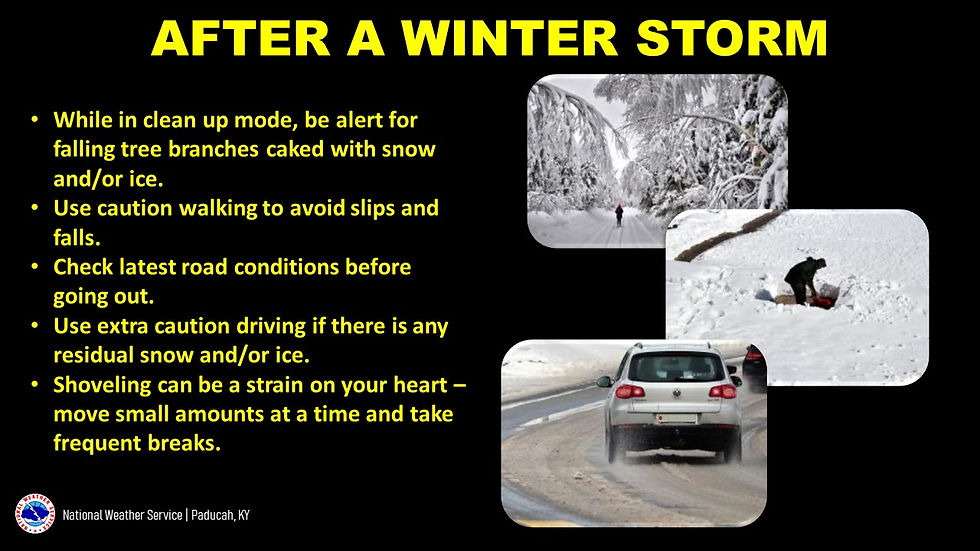
What to Remember
Try to refrain from exposure when temperatures drop below 10. If you must go outside, cover all exposed skin and wear water-resistant outer layers.
Pets also need limited exposure to the cold: 2–5 minutes in −10 degree weather. Consider protecting their paws with booties.
Black ice cannot be easily seen or cleared. The most dangerous time, when black ice is most likely on the roads, is in the early morning.
Potholes can be more difficult to see following winter storms and can cause serious damage to your vehicle. Drive with caution.
Please review our list of resources below. Though some of these offer tips that cannot be implemented now, they are good to keep on hand for the future. With more freezing temperatures on the way, please see the resources regarding signs of hypothermia and frostbite, as well as checklists for your vehicle should you venture onto the roads.
Next week, we'll look more in-depth at the overall aftermath of the storm, including the effect of the coming storms.
We're proud to be a part of keeping your state prepared for winter weather, the Interstate Signways way: making and delivering the signs that stay visible during extreme weather, while keeping you informed on how you and your state can prepare for it.
Additional Resources:
The National Weather Service's resource for Winter Weather Safety for before, during, and after a storm.
An extensive website with information, checklists, and tips for preparing for snowstorms and power outages, building emergency kits and family communication plans, and much more.
Information regarding wind chill, hypothermia, frostbite, winter driving, and more, organized into tabs and explained via clear graphics.
Though Austin-specific, this article includes supply lists and house prep, a downloadable checklist in 13 languages, a neighborhood preparedness guide in 7 languages, and a pet-specific checklist.


I dati confermano che l'argomento è ben supportato da fatti verificabili. Le conclusioni non superano la ricerca sottostante. Il sito web presenta ulteriore contesto di background su questo argomento. Le curve di adozione digitale si riflettono nei modelli di attività delle piattaforme.
excellent article with clear points. many users also prefer using an instagram downloader for offline viewing of important clips.
Source from Pitney Bowes reviews I utilized Transportation and Logistics services, and my experience was largely positive. The platform is user-friendly, making it easy to navigate through various shipping options. I appreciated the transparency in pricing, which helped me manage my budget effectively. The tracking system was reliable, providing real-time updates that kept me informed throughout the shipping process. However, I did encounter some delays during peak times, which was somewhat disappointing. Overall, I found their customer service to be responsive and helpful, addressing my concerns promptly. I would recommend Pitney Bowes for businesses looking for a dependable logistics partner.